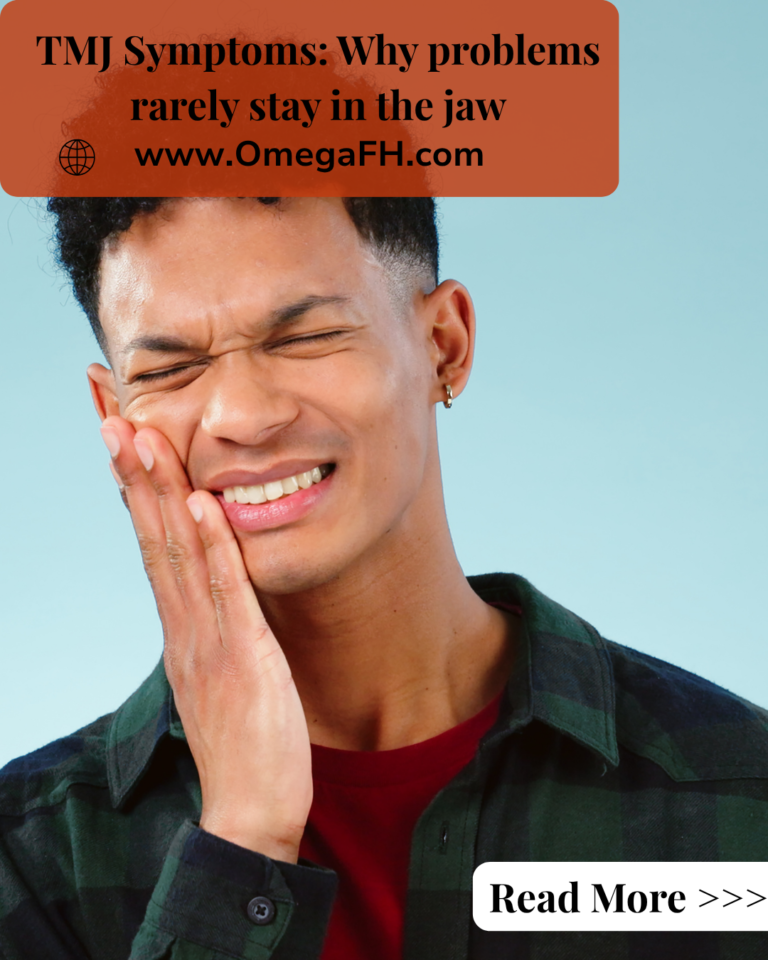

Can TMJ Cause Neck Pain?
Yes. Jaw dysfunction and neck pain are strongly associated, and the relationship runs in both directions jaw problems can contribute to neck pain, and neck problems can contribute to jaw pain. They share muscle attachments, they share nerve pathways in the brainstem, and they work together every time you chew, swallow, or speak.
Which means treating one while ignoring the other often produces relief that does not last.
If you grind your teeth and have a chronically tight neck, or you have had neck pain for years and your jaw clicks, those are unlikely to be two separate stories.
What this actually is
TMJ refers to the temporomandibular joint, the hinge connecting your jaw to your skull just in front of each ear. When that joint or its associated muscles are not working well, the clinical term is temporomandibular disorder, or TMD.
The jaw and the upper neck are neighbors in every meaningful sense. Muscles that move the jaw attach to structures that also influence the head and neck. The muscles at the base of the skull help stabilize the head so the jaw has something firm to work against. And sensory information from the jaw and from the upper cervical spine converges on the same region of the brainstem the trigeminocervical complex.
That convergence is why pain in this area is so difficult to localize. The brain receives signals from two territories through one shared pathway, so jaw irritation can be felt in the neck and neck irritation can be felt in the jaw or face.
What happens when it persists
People adapt in ways they do not notice. Chewing shifts to one side. The jaw sits slightly forward or clenched. Head position adjusts subtly to give the jaw a more comfortable working angle.
Every one of those adaptations asks the neck to do something different than it was doing before. Muscles that were not designed for a sustained holding job start doing one.
Meanwhile the jaw problem is usually managed on its own terms a night guard, dental evaluation, advice to stop clenching. Those can be genuinely useful. But if part of what is driving the clenching is a neck and head that are working hard to stabilize, the guard protects the teeth without addressing the reason the muscles are firing.
So the pattern continues. The neck gets tighter. The jaw stays reactive. Both get treated as separate problems by separate providers, neither of whom is wrong, and the person in the middle keeps having both.
What it costs over time if it is not addressed
Jaw and neck pain together erode things people rarely connect back to the source.
Eating becomes something you think about. You avoid the chewy foods, the big sandwich, the steak. Meals out get less appealing. Some people describe becoming quieter in conversation because extended talking makes the jaw ache by evening.
Sleep is commonly affected, both from the pain itself and from nighttime clenching or grinding. Morning headaches become routine. Many people wake already tired and already sore, which sets the tone for the entire day before it starts.
There is also a cumulative dental cost that is easy to overlook worn enamel, cracked teeth, repeated dental work addressing damage that keeps recurring because the force producing it never changed.
Over years this becomes a background hum of discomfort that people stop mentioning because it has always been there.
The reframe
The productive question is not “how do I stop clenching.”
It is: why hasn’t your body healed this problem?
Clenching is usually not the disease. It is often the visible output of something else a system working hard to stabilize, a nervous system running with the alarm partially engaged, or a compensation that started somewhere else entirely. Addressing the output while leaving the driver in place is why so many people cycle through night guards without lasting change. Finding the driver first is the whole point of the Omega Method.
What may actually be driving it
Three layers, and most care addresses only the local one.
The balance and coordination system. Your head weighs a substantial amount and sits on top of a mobile column. Keeping it stable is a full-time job for the nervous system, and it uses eyes, inner ear, and neck position sense to do it. If the vestibular system is underperforming, the muscles of the head, neck, and jaw are recruited harder to provide stability the balance system is not supplying. In practice this can look like a chronically braced jaw and neck with no obvious mechanical explanation because the explanation is not mechanical, it is a compensation.
Whole-body tension patterns. The connective-tissue network is continuous. Tension established elsewhere an old injury, an asymmetric work posture, a gait pattern altered years ago can travel upward and increase load through the neck and jaw. When that is the case, local jaw treatment addresses the last link in a chain rather than the chain.
Local tissue involvement. There may also be genuine unresolved tissue issues in the jaw musculature and the surrounding neck structures persistent trigger points, poor tissue quality, restricted movement that never fully returned after an injury or a long dental procedure.
Which of these applies is not something to guess at from symptoms.
Because these systems share so much wiring, jaw and neck problems rarely arrive alone. Many people with this pattern also have headaches driven by the neck, and some have unexplained dizziness alongside the neck pain. If the clenching is worst overnight, sleeping with neck pain covers why the problem often does not settle just because you lay down.
How we approach it at Omega Functional Health
We evaluate both regions and the system coordinating them. Assessing the jaw without assessing the neck, or either without assessing balance function, leaves out information that frequently turns out to matter.
Using Cognuro, we measure how the eyes, inner ear, and body position sense are working together which tells us how much stabilizing work the neck and jaw are being asked to absorb. This is not typically part of a TMJ workup.
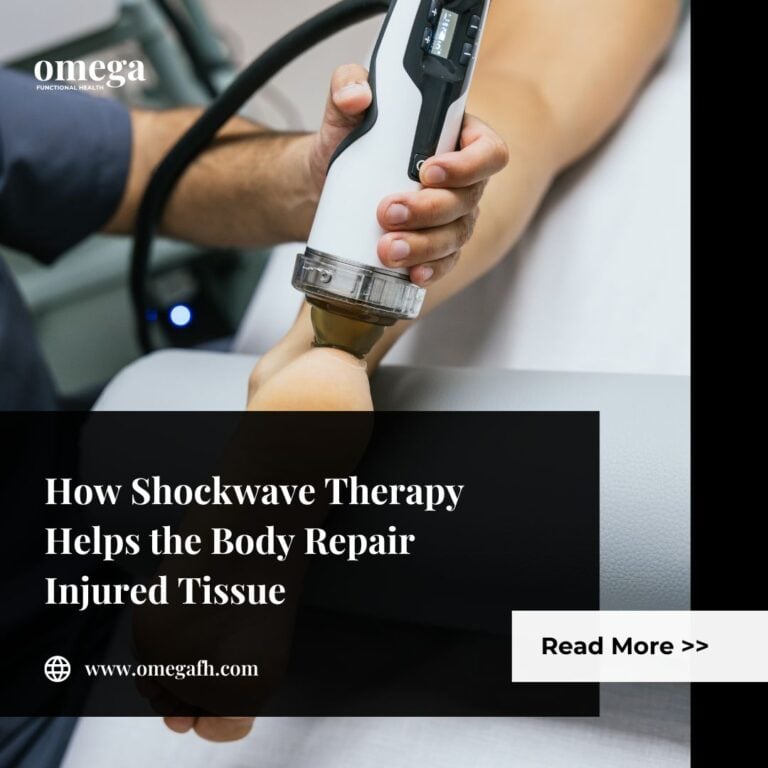
Where there is tissue involvement, focused shockwave therapy can be applied to the jaw musculature and the surrounding neck structures. Focused shockwave is the same underlying technology used in lithotripsy for kidney stones, delivered at low energy used to reduce inflammation, improve blood flow, and stimulate the body’s own repair response rather than to break anything apart. It is gentle enough to use around the head, neck, and TMJ.
Where the balance system is contributing, care may include the Gravity Reset Method and specific home exercises drawn from your testing.
Should I see a dentist or a chiropractor for TMJ pain?
Often both, and the sequencing depends on your situation.
Dentists are essential for the dental side evaluating the joint and bite, identifying damage, and fitting a night guard where appropriate. If you have tooth damage, significant bite changes, or a locking jaw, start there.
What is frequently missing is evaluation of the muscular and neurological side, particularly the neck’s involvement and the balance system’s role. Many people arrive having done the dental work correctly and still having symptoms, which is usually a sign that something outside the dental scope is contributing.
We coordinate with dental providers rather than replacing them.
Does this replace conventional medical or dental care?
No.
Jaw locking, significant trauma to the jaw, suspected fracture, dental infection, or a sudden change in how your teeth fit together all require appropriate dental or medical evaluation. Facial pain also has causes outside the musculoskeletal system that need proper workup.
Our contribution is assessment of the muscular, cervical, and neurological contributors, most useful for people who have addressed the dental side and still have symptoms.
Who this may help
- Adults with jaw pain and neck pain occurring together
- People who clench or grind and have chronic neck tightness
- Jaw clicking or popping alongside limited neck mobility
- Morning headaches with jaw or neck soreness
- People who have used a night guard without full resolution
- Jaw or neck symptoms following a car accident or head or neck injury
- Anyone whose jaw and neck have been treated separately without lasting change
What does the research say?
The association between temporomandibular disorders and cervical spine dysfunction is well documented.
A 2020 systematic review and meta-analysis found a statistically significant association between neck disability and jaw disability in people with TMD, along with moderate evidence for lower pressure pain thresholds and limited cervical range of motion in this population. Interestingly, the same analysis found no significant association with craniocervical posture measurements suggesting the relationship is more about shared neurology and muscular function than about posture as such, which runs counter to how the connection is often explained.
A 2026 study in the European Journal of Oral Sciences examining people with cervical disc herniation found high rates of temporomandibular disorder in that group, with greater neck disability associated with greater TMD severity and jaw pain. The authors point to the trigeminocervical nucleus as an anatomical and functional crossroad for signals from both the upper cervical spine and trigeminal pathways.
Regarding shockwave therapy, a 2020 meta-analysis of eleven randomized controlled trials found meaningful improvements in pain and pressure pain threshold for myofascial pain in the neck and shoulder region, with focused shockwave performing well in subgroup analysis.
Direct research on shockwave for TMD specifically is more limited than for other regions, and that limitation deserves to be stated plainly.
If this sounds like your situation
If your jaw and your neck have both been problems and they have been handled as separate issues, looking at them together along with the balance system that influences both may be the missing piece.
Every person is different and we cannot promise a particular outcome but we can tell you what we find, and build your care around it. Omega Functional Health serves Wheat Ridge, Denver, Arvada, Lakewood, Golden, Littleton, and surrounding Colorado communities.
Schedule a Complimentary Consultation
References
- Garrigós-Pedrón M, et al. Craniocervical and Cervical Spine Features of Patients with Temporomandibular Disorders: A Systematic Review and Meta-Analysis of Observational Studies. Journal of Clinical Medicine. 2020. PMC7565821
- Altunalan T, et al. Temporomandibular disorders and neck disability in individuals with cervical disc herniation. European Journal of Oral Sciences. 2026. doi:10.1111/eos.70047
- Jun JH, et al. The Effect of Extracorporeal Shock Wave Therapy on Pain Intensity and Neck Disability for Patients With Myofascial Pain Syndrome in the Neck and Shoulder: A Meta-Analysis of Randomized Controlled Trials. American Journal of Physical Medicine & Rehabilitation. 2021;100(2):120-129. PMID: 32520797
- Weber P, et al. Cervical spine dysfunction signs and symptoms in individuals with temporomandibular disorder. 2012. PMID: 22832680
Learn more about how we find what keeps neck pain coming back on our neck pain page, and how we find what keeps headaches coming back on our headaches and migraines page.