
Neck Pain Treatment in Denver
For neck pain that keeps coming back, even after you’ve tried everything.
Serving the Denver metro from Wheat Ridge
The short version
Neck pain that keeps coming back usually isn’t just a neck problem. At Omega Functional Health in Wheat Ridge, we test your posture, eye tracking, and balance to find what’s keeping your neck muscles tight, then build care around those results.
Does this sound familiar?
- Your neck feels better for a day or two after treatment, then it’s right back
- Turning your head to check your blind spot is stiff or painful
- Headaches that start at the base of your skull
- You sometimes feel off, foggy, or a little unsteady
- Your MRI or X-ray came back “normal,” but you still hurt
- You’re tired of managing symptoms instead of understanding what’s causing them
If you nodded at two or more, you’re who we built this practice for.
Where long-standing neck pain often starts
Most of the people we see can point to a moment, or a slow buildup:
- A car accident or whiplash, even one that seemed minor at the time
- A fall, sports injury, or concussion
- Years at a desk or looking down at a phone
- A previous surgery or injury somewhere else in the body that changed how you carry yourself
Sometimes there’s no clear starting point at all. Either way, the question we answer is the same: what’s keeping it going now?
Why neck pain keeps coming back
Neck pain isn’t always just a neck problem. Sometimes the neck is where the problem shows up, not where it starts.
Your brain’s number one job is keeping you upright. It does that using three streams of information: your eyes, the balance system in your inner ear, and signals from the joints and muscles throughout your body.
When your balance system isn’t working well, your brain senses you’re more likely to fall. And if you fall, the thing it most wants to protect is your neck. So it does the logical thing and tightens up your neck muscles, like bracing for impact. It’s a smart, protective reflex. The problem is that it never gets the all-clear.
Over time, the joints carrying that extra tension can build up scar tissue that makes the pain stubborn.
That’s why relief can be temporary when the underlying driver hasn’t been measured. Your neck muscles are following orders from your brain. Finding out why your brain is giving those orders is what we focus on.
How we find what’s driving your neck pain
We measure before we treat, and we keep measuring.
- Posture analysis: we check weight distribution side to side, how your hips and shoulders rotate, and how your head and neck tilt.
- Eye tracking and balance testing: computerized testing (VNG and posturography) shows how your eyes and balance system are performing.
- A focused exam of the joints that are carrying the load.
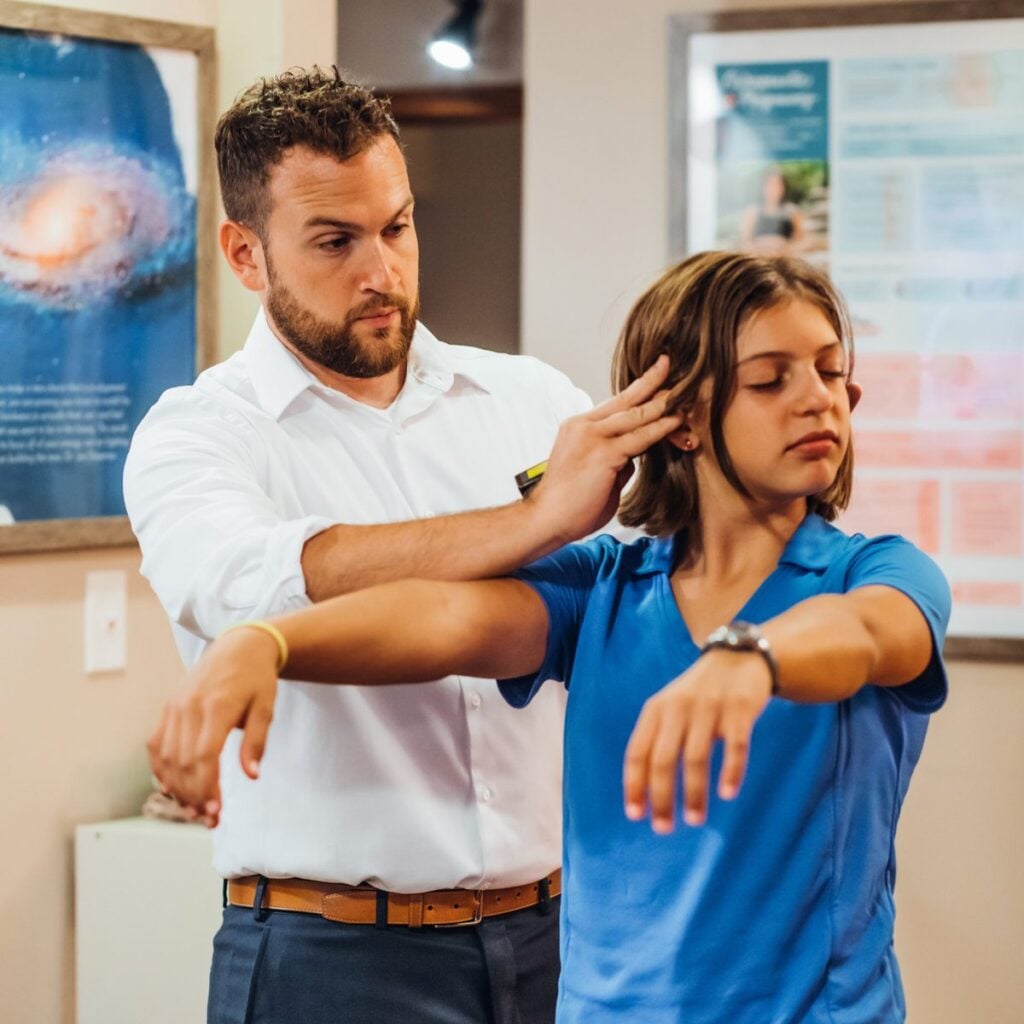
What care looks like
Care is weighted to your results, not a fixed protocol. It’s built on the two parts of The Omega Method:
- Upper cervical chiropractic: a precise, gentle correction calculated from your posture measurements, so it changes as you change.
- Vestibular therapy: in-office and home exercises for your eyes and balance system, each one tested against your results before we assign it.
When scar tissue in a joint is part of the problem, focused shockwave therapy may be added. Your exam decides.
Progress is re-measured along the way, so you see the change in data, not just in how you feel on a given day.
What this looks like in practice
A 56-year-old woman came to us after 17 years of neck pain. It caused daily headaches and numbness and tingling in both hands. It took her an hour and a half to fall asleep, and she woke three to four times a night. Her X-rays showed degenerative disc disease at multiple levels and moderate to severe arthritis. She had already tried chiropractic care, massage, Botox injections, acupuncture, and pain medication, and was considering nerve ablation and spinal fusion.
What testing showed: on balance testing with her eyes closed on an unstable surface, she scored 14%.
What care included: 12 weeks of chiropractic adjustments, focused shockwave therapy, and vestibular therapy.
How it went:
- Week 4: balance up to 44%, headaches stopped, neck pain down 30%
- Week 8: balance up to 70%, still no headaches, falling asleep within 30 minutes and waking 0 to 1 times a night
- Week 12: neck pain at 1 out of 10, no headaches, no numbness or tingling, balance at 88%
Individual results vary. Details are shared with the patient’s permission and de-identified.
“For the better part of a year, I lived with neck pain that felt like a vise grip on my trapezius and an ice pick in the middle of my neck. It stayed between a four and six out of ten—always there, always exhausting. Despite physical therapy, foam rolling, a lacrosse ball, heat, and red light therapy, I couldn’t get lasting relief.
That changed when I started working with Dr. Sam McDonald at Omega Functional Health. He combined vestibular therapy with shockwave therapy, two treatments I hadn’t experienced before. I’ll admit I was skeptical of the vestibular exercises at first, but I followed the program. Over eight weeks, the improvement was remarkable. Most days, I barely notice my neck. When I do, it’s usually mild discomfort in the morning, around a two out of ten, that fades once I get moving.
What really stood out was my last visit. I mentioned hurting my ribs playing hockey but hadn’t told Dr. Sam that I’d also fallen and bumped my head. After reviewing my vestibular assessment, he asked whether I’d bumped my head. I was stunned. He repeated the assessment and worked through several targeted exercises with me to determine the right approach. That experience gave me a much deeper appreciation for his attention to detail and the individualized care I was receiving.
I’ve decided to continue with additional sessions to build on that progress and support my ongoing health.
Thank you, Dr. Sam and the Omega Functional Health team. I’m grateful to finally have relief from something that had worn me down for so long.”
Keith B., Google review
“I suffered with neck and shoulder pain and after the work done by Dr. Sam my pain has lessened significantly. The environment is welcoming and Dr. Sam is very knowledgeable and invested in his patients. I’m glad I was referred to Omega Functional Health. Both Dr. Sam & Dr. Lynn are awesome and kind.”
Cindy L., Google review
“It’s been wonderful working with Dr. Sam and Dr. Lynn. Major improvement in the big things I first showed up with just over four months ago. We’re already onto the next layer which I think is what started the whole cascade of other symptoms. I’ve worked with many practitioners over the years and I finally feel like we’re resolving and re-patterning things vs just being in a cycle of treatment. Highly recommend! Thank you Dr. Sam and Dr. Lynn!”
Kristen R., Google review
Common questions about neck pain
Can a chiropractor help with neck pain that won’t go away?
Chiropractic care can help many people with chronic neck pain, especially when it’s based on measurement rather than habit. Our approach combines upper cervical chiropractic with balance and eye testing, because in long-standing cases the neck is often compensating for something else.
Why does my neck pain keep coming back?
Often because your brain is protecting you. If your balance system isn’t working efficiently, your brain tightens your neck muscles to guard against a fall, and it keeps doing that until the balance problem is addressed. Treating the tight muscles alone doesn’t change the signal.
Can you help with neck pain from a car accident?
Yes. Whiplash can affect the joints of the upper neck as well as the balance and eye systems, which is why symptoms like headaches or dizziness sometimes show up weeks later. We test all three.
Can neck pain cause dizziness?
Yes. The joints and muscles in your upper neck feed your brain information about head position. When that information is off, it can contribute to dizziness or unsteadiness. Read more: Can neck pain cause dizziness?
Can neck pain cause headaches?
Yes. Headaches that start at the base of the skull and wrap forward are commonly linked to the upper neck. Read more: Can neck pain cause headaches?
Should I stop physical therapy or other care while I’m seeing you?
Not necessarily. Many of our patients continue working with their physical therapist, massage therapist, or physician. Our testing often adds information that helps the rest of their care team, and we’re happy to coordinate.
I’ve already had neck surgery. Can you still help?
Many of the people we see have had surgery or injections and still have pain. We evaluate the posture and balance factors that can contribute to ongoing symptoms. This allows us to look at the whole picture of why you may still be having issues despite more invasive procedures.
How many visits will I need?
It depends on your findings. We re-measure early in care, so you and we both know within the first few weeks whether things are improving.
Do I need a referral?
No. You can schedule a complimentary consultation directly.
Do you take insurance?
We are out of network with all carriers but can provide you with a superbill to submit for reimbursement.
Related conditions
Further reading
Still dealing with neck pain? Let’s measure what’s actually going on.