Shockwave Therapy or Custom Orthotics for Plantar Fasciitis: Which Should Come First?
Written and medically reviewed by Dr. Sam McDonald, DC
If you’ve spent any time researching plantar fasciitis treatment, you’ve likely come across two options mentioned again and again: shockwave therapy and custom orthotics.
Patients often ask which one they should try first, as though it’s a choice between competing treatments. In most cases, that’s the wrong way to frame the decision.
Shockwave therapy and custom orthotics address different parts of the same problem. Understanding what each one actually does, and doesn’t do, makes it much easier to figure out how they fit together for your specific case.
What Custom Orthotics Actually Do
Custom orthotics are designed to change how load is distributed across your foot while you stand, walk, or run. By supporting the arch and controlling excess motion, they can reduce the mechanical strain placed on the plantar fascia with every step.
For people whose plantar fasciitis is heavily influenced by foot structure, such as flat feet or an unusually high arch, orthotics can meaningfully reduce the day-to-day irritation that keeps symptoms from settling down.
What orthotics generally do not do is directly stimulate healing in fascia tissue that has already become degenerated. They manage the mechanical environment around the injury; they don’t repair the injury itself.
What Shockwave Therapy Actually Does
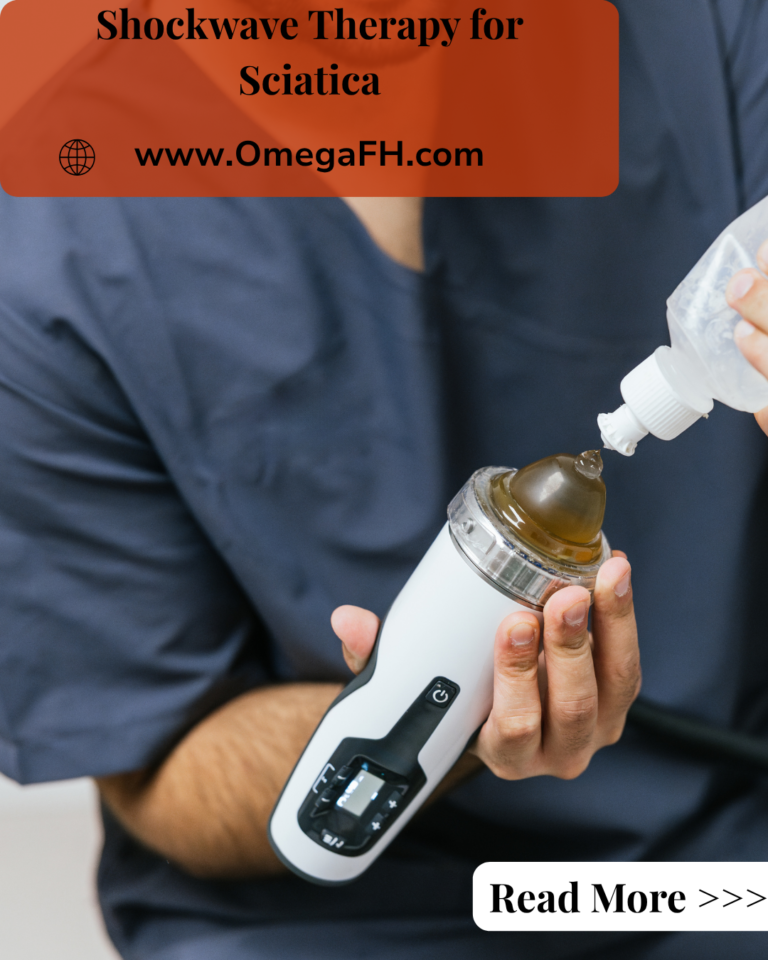
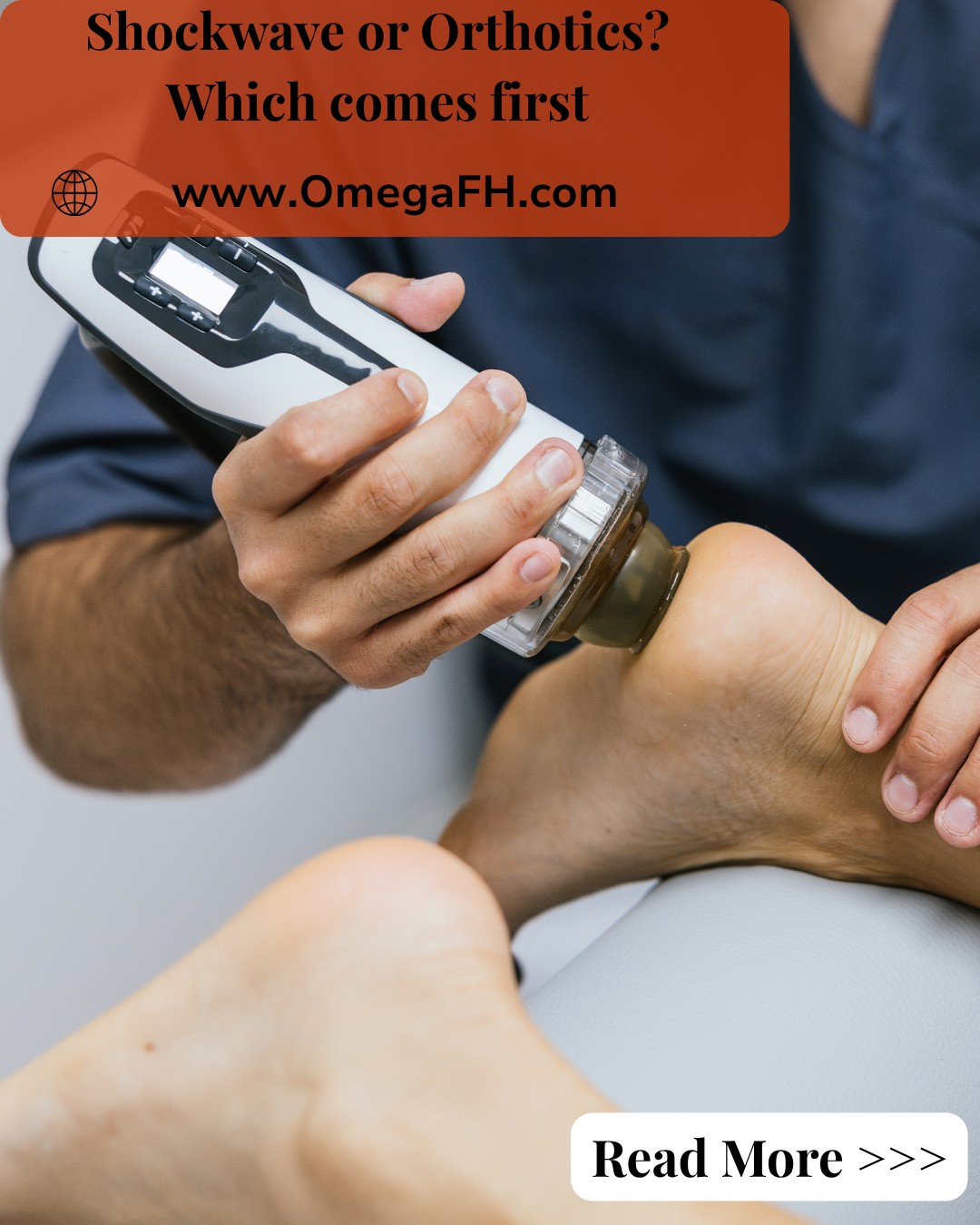
Shockwave therapy works on the tissue directly. Acoustic pulses delivered to the plantar fascia are thought to stimulate blood flow, encourage the breakdown of degenerated tissue, and promote new collagen formation, essentially giving stalled healing a mechanical nudge to restart.
What shockwave generally does not do is correct the underlying biomechanics that contributed to the problem in the first place. If your fascia keeps absorbing excess strain because of how your foot moves, shockwave can help the tissue heal, but it doesn’t change the mechanical pattern that put stress on it to begin with.
Why “Which First” Is Often the Wrong Question
Framed this way, the two treatments are addressing different variables in the same equation: tissue healing on one side, mechanical load on the other. For many patients, particularly those with a clear structural contributor to their symptoms, using both together tends to produce a more complete result than either alone.
That said, sequencing and timing decisions still matter, and they depend on your specific presentation.
When Orthotics Might Reasonably Come First
- Symptoms are relatively recent, and there’s a clear structural or footwear-related contributor
- There hasn’t yet been a real trial of supportive footwear or off-the-shelf arch support
- The person prefers to start with the least invasive option and progress from there
- Cost or insurance timing favors starting with orthotics while a shockwave referral or authorization is processed
When Shockwave Might Reasonably Come First
- Symptoms have been present for several months, suggesting more degenerative tissue changes that orthotics alone are unlikely to resolve
- Orthotics or supportive footwear have already been tried without meaningful relief
- Pain is significant enough to limit basic daily activity, and faster tissue-level progress is a priority
- There’s a strong desire to avoid cortisone injections or surgical consultation, and shockwave is being used as the next reasonable step
When Doing Both Together Makes the Most Sense
For many chronic cases, particularly those with an identifiable structural contributor, starting orthotics around the same time as a shockwave course allows the mechanical environment to improve while the tissue itself is healing. This can help protect the gains made during treatment, since reduced strain on the fascia may lower the chance of symptoms returning once treatment concludes.
This is not a universal recommendation. Whether combining the two makes sense, and in what order, depends on your evaluation findings, not a one-size-fits-all protocol.
A Word on Off-the-Shelf vs. Custom Orthotics
Not everyone needs a custom-molded orthotic. Some patients do well with a quality off-the-shelf arch support, particularly when the foot structure involved is relatively mild. Custom orthotics tend to matter more when foot structure is significantly atypical, when off-the-shelf options haven’t helped, or when other lower-body mechanics need to be addressed alongside the foot itself. A gait and structural assessment is generally the best way to determine which category you fall into, rather than assuming custom is always necessary.
Does Combining Treatments Replace a Proper Evaluation?
No. Neither shockwave therapy nor orthotics, alone or combined, substitutes for ruling out other causes of heel pain, such as tarsal tunnel syndrome, a calcaneal stress fracture, or Achilles tendinopathy. Sequencing decisions should follow an accurate diagnosis and a clear understanding of what’s driving your specific case, not the other way around.
Who This Sequencing Question Applies To
- Patients recently diagnosed with plantar fasciitis trying to plan their treatment approach
- Those who have already tried one option without full relief and are considering the other
- Patients with a known structural foot pattern, such as flat feet or high arches, contributing to their symptoms
- Anyone unsure whether they need both treatments or just one
What the Research Says About Combining Approaches
Research directly comparing combined shockwave-and-orthotic protocols against either treatment alone is more limited than research on shockwave by itself, and results vary depending on the study population and orthotic type used. What is better established is that shockwave therapy performs well for chronic, degenerative plantar fasciitis, and that biomechanical support through orthotics is a reasonable, low-risk addition when a structural contributor is identified. Because comparative research is still developing, an individualized recommendation based on your specific findings is more reliable than a generic combined protocol.
Getting a Recommendation Based on Your Specific Case
At Omega Functional Health, sequencing decisions like this come out of a full evaluation, not a standard script applied to every patient. We look at how long symptoms have been present, what your foot structure and gait look like, what you’ve already tried, and how your broader movement patterns may be contributing, before recommending an order of operations.
If you’re trying to decide between shockwave therapy, orthotics, or both for your plantar fasciitis, our team serves patients throughout Wheat Ridge, Denver, Arvada, Lakewood, Golden, Littleton, and the surrounding Colorado communities with individualized evaluations and care planning.
References
Chew KTL, Leong D, Lin CY, Lim KK, Tan B. Comparison of autologous conditioned plasma injection, extracorporeal shockwave therapy, and conventional treatment for plantar fasciitis: a randomized trial. PM R. 2013;5(12):1035-1043.
Landorf KB, Keenan AM, Herbert RD. Effectiveness of foot orthoses to treat plantar fasciitis: a randomized trial. Arch Intern Med. 2006;166(12):1305-1310.
Yin MC, Ye J, Yao M, et al. Is extracorporeal shock wave therapy clinical efficacy for relief of chronic, recalcitrant plantar fasciitis? A systematic review and meta-analysis of randomized placebo or active-treatment controlled trials. Arch Phys Med Rehabil. 2014;95(8):1585-1593.
Learn more about how we approach stubborn tendon and joint pain on our joint and tendon pain page.