
Joint and Tendon Pain Treatment in Denver
For knee, shoulder, hip, elbow, or foot pain that’s been hanging on for months or years, even after rest, injections, or surgery.
Serving the Denver metro from Wheat Ridge
The short version
Joint and tendon pain that won’t resolve usually has two layers: tissue that’s stopped healing, and a joint that’s carrying more load than its share. At Omega Functional Health in Wheat Ridge, we address both, in that order.
Does this sound familiar?
- Stairs, squats, or getting out of a chair hurt your knees
- You can’t reach overhead or sleep on one shoulder
- Your first steps in the morning are the worst of the day
- The pain comes right back as soon as you get active again
- You rested it like you were told, and it still hurts
- You’ve been told injections or surgery are the next step
If you nodded at two or more, you’re who we built this practice for.
Joint and tendon pain we see most
- Knee pain: stairs, kneeling, running, or pain that lingers after an old injury or surgery.
- Shoulder pain: trouble reaching, lifting, or sleeping on one side.
- Hip pain: deep ache with walking, stairs, or lying on your side.
- Elbow pain: tennis elbow and golfer’s elbow from gripping, lifting, or repetitive work.
- Plantar fasciitis and heel pain: sharp pain with your first steps or after sitting. (Plantar fasciitis recovery, week by week)
- Achilles pain: tightness or pain at the back of the heel.
Why joint and tendon pain won’t heal
Most long-standing joint and tendon pain has two layers.
The first is the tissue itself. When a tendon or joint is strained over and over, your body lays down scar tissue to protect it, like putting a cast on the area. That scar tissue has poor blood flow and doesn’t move well, so the area gets stuck in a low-grade cycle of repair that never finishes. That’s what chronic tendonitis often is.
The second is the load. Almost nobody stands evenly. You might be carrying 60 percent of your weight on one leg and 40 on the other, and it feels perfectly normal to you, because your brain has been holding you that way for years. You’d only notice it on a scale that measures each foot separately.
That uneven stance isn’t random. Your brain’s number one job is keeping you upright, and when the information from your eyes, inner ear, and body doesn’t add up, it braces to protect you. Your body twists and shifts to follow, and that pattern becomes your normal.
The leg carrying more weight takes extra load with every step you take, every day, for years. That’s the knee, the hip, or the foot that gives out first, and it’s usually the side that hurts. The scar tissue that builds up there sends its own distorted signal back to your brain, which tells it to keep bracing.
That uneven load leaves the tissue around it in one of two states, and they don’t respond to the same thing.
Tension
A muscle or tendon held at full stretch, working to hold you in place. Picture a rope pulled tight and never let go. It aches, it feels tight no matter how much you stretch it, and it’s usually sore right where it attaches to bone.
Compression
The opposite: something getting squashed. A joint on the heavy side, a disc, or a nerve caught between structures. Compression hurts with weight and pressure, and it often eases as soon as you take the load off.
This is why the exercises you found online may not have helped. Stretching tissue that’s already at maximum tension doesn’t release it, and loading a joint that’s being compressed just adds to the problem. Sorting out which one you’re dealing with is what makes a plan work.
What we test
- A focused exam of the joint or tendon: where it hurts, how it moves, and where scar tissue has built up.
- Posture analysis: how much weight you put on each leg, and how twisted your hips and shoulders are. If one side is taking more than its share, that’s usually the joint that wears out first.
- Balance testing: how steady you are on each leg. Knees, ankles, and feet take a beating when your balance is doing extra work.
What care looks like
Care is weighted to your results, not a fixed protocol. It can include:
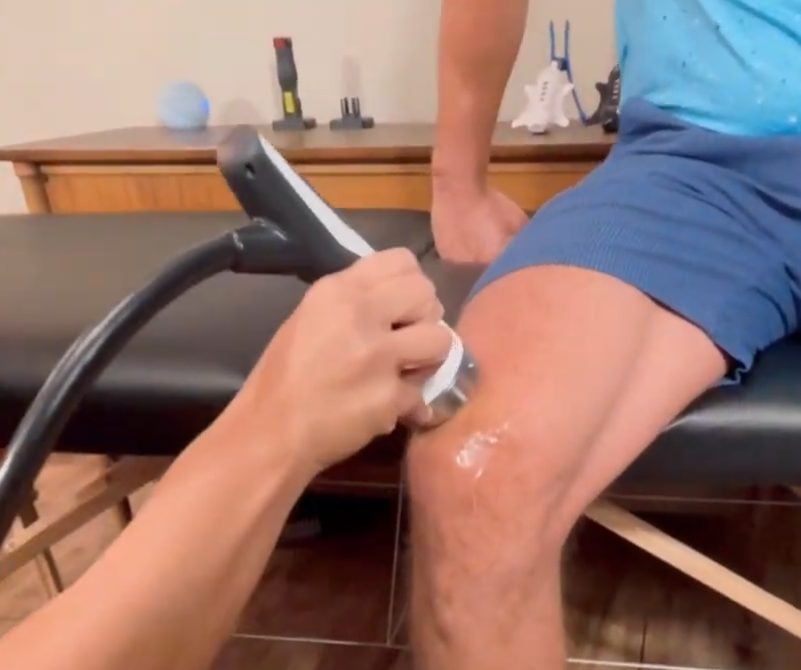
- Focused shockwave therapy: sound waves directed at the exact spot to break up scar tissue and restart your body’s repair process.
- Upper cervical chiropractic: when your posture is loading the joint, a precise, gentle correction calculated from your measurements.
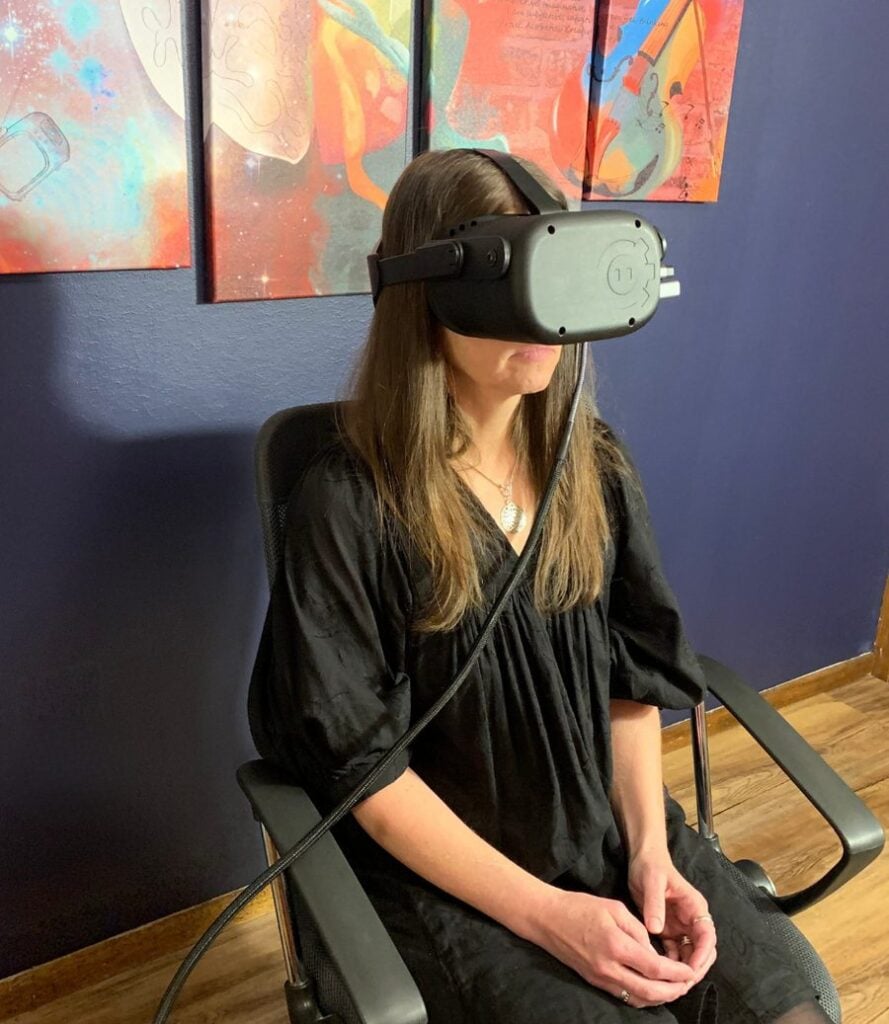
- Vestibular therapy: helps your body carry weight more evenly, so the joint isn’t doing more than its share.
Care follows a sequence: heal the tissue first, then rebuild strength once it can handle load again.
Progress is re-measured along the way, so you see the change in data, not just in how you feel on a given day.
Coming in specifically for shockwave therapy? You can schedule it directly.
What this looks like in practice
“This was absolutely the best experience for me! Dr. Sam is knowledgeable and told me what to expect. I had a 15 year old knee injury. It was keeping me from doing simple things . Walking up and down stairs was painful. After a few sessions it was amazing how I was healing and feeling better! Thank you so much!”
Kelley R., Google review
“My lower back, left knee and right ankle have extremely limited my mobility for the last few years… About a month ago I started the sessions. Last week I ran on the treadmill for the first time. The best thing is the next day I woke up and didn’t feel any pain in my lower back knee or ankle… I can finally workout and run again without the fear of waking up the next morning in severe pain. I feel better than I have in years.”
Jason P., Google review
Individual results vary.
Common questions about joint and tendon pain
Why hasn’t my knee healed after all this time?
Long-standing joint and tendon injuries often stall for two reasons. The tissue itself has built up scar tissue with poor blood flow, so repair never finishes, and the joint may still be carrying more load than its share because of how you stand and move. Addressing one without the other is why pain tends to come back.
Is it too late if this has been going on for years?
Usually not. Most of the people we see have had their pain for years, and the tissue involved is still capable of repair once it gets the right stimulus and the load comes off it.
Can I keep exercising during care?
Yes, but timing matters. You don’t want to rehab or strengthen tissue that’s still broken. Strengthening asks a tissue to carry load, and tissue that hasn’t started healing can’t do that yet, which is why people often feel fine during a workout and worse the next day. We use shockwave to get the tissue repairing first, then add strengthening once it can bear load again. In the meantime we’ll tell you what’s safe to keep doing, and usually that’s more than people expect.
What if I’ve been told I need surgery or injections?
Many of the people we see have. It’s reasonable to find out first whether the tissue can repair on its own and whether the load pattern driving the problem can change.
Is knee pain always a cartilage or meniscus problem?
Not always. Imaging often shows changes that aren’t the source of the pain. Tendons, scar tissue, and how weight falls through the joint all matter, which is why we measure before deciding what to treat.
Can shockwave therapy help my knee, shoulder, or plantar fasciitis?
Focused shockwave works on scar tissue in tendons and joints that have stopped healing. Whether it’s right for you depends on what your exam finds. Read more about focused shockwave therapy
How soon will I know if this is working?
We re-measure along the way, so you’ll have objective information within the first few weeks rather than relying on how you feel on a given day.
Do I need a referral?
No. You can schedule a complimentary consultation directly.
Do you take insurance?
We are out of network with all carriers but can provide you with a superbill to submit for reimbursement.
Related conditions
Further reading
Still dealing with joint pain? Let’s find out why it hasn’t healed.